
What is dental phobia?

Last updated on August 26, 2026
Ambling along an innocent-looking road, you pass a sign for a dental surgery. Immediately, your heart starts racing, you break out in a cold sweat, and you feel shaky and nauseous. Argggh, not yet another reminder of the dreaded D-word – better cross that road and face the other way!! Is that you? You may be suffering with dental phobia.

Dental phobia refers to an extreme fear of the dentist. It is often used as an umbrella term which can involve many different fears or one specific fear.
You may spend an awful lot of time thinking about your teeth or dentists or dental situations, or else spend a lot of time trying NOT to think about teeth or dentists or dental situations. This can be pretty hard in today’s society, which is saturated with ugly reminders such as toothpaste commercials.
Table of contents
- The difference between dental anxiety, fear and phobia
- How is dental phobia different from other phobias?
- What causes dental phobia and anxiety?
- Other mental health issues and dental phobia
- How common is dental phobia?
- The impact of dental phobia on daily life
- There is a light at the end of the tunnel…
The difference between dental anxiety, fear and phobia
People often use the terms dental anxiety, fear and phobia to mean the same thing. Sometimes they use them to express a continuum of severity, ranging from mild (anxiety) to more extreme (phobia). At other times, “dental phobia” is used to describe an extreme fear that doesn’t respond to TLC and that is seemingly irrational and particularly hard to overcome.
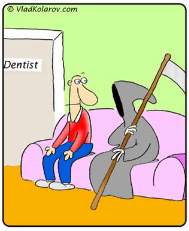
A perhaps more useful way of distinguishing between anxiety, fear and phobia is as follows:
- Dental anxiety is a reaction to a potential, anticipated danger 1. Most people have some degree of dental anxiety, especially if they’re facing a procedure which is new to them. Often, it’s a fear of the unknown – the “uncertainty factor”.
- Dental fear tends to be far more specific. If somebody has a fear, they can usually tell you what exactly it is they’re scared of 2. Common examples include needles, pain, gagging or being humiliated. If you have a lot of different dental fears, pinpointing them can become a little overwhelming. But you should be able to identify them with some prompting.
- If you have a dental phobia, the terror you feel is so strong that you avoid the dentist until either the physical pain or the emotional burden of the phobia becomes overwhelming. Some people, for various reasons, may still attend a dentist. But they will endure these encounters with intense fear or anxiety.3

When you’re in the depth of a dental phobia, this cute teddy may strike you as pretty frightening (a dentist in teddy’s clothing) – yet another reminder of your worst nightmare…
Phobias are sometimes described as irrational or greatly exaggerated fears. But once you start digging a little deeper, this usually isn’t the case with dental phobia.
How is dental phobia different from other phobias?
At the moment, dental phobia is treated as a type of Blood-Injection-Injury (BII) specific phobia4. This type of phobia also includes needles and invasive medical procedures.
The problem is that dental phobia shouldn’t be classed under BII phobia – it should really have its own category. Some dental phobics do have a very specific fear of needles and may faint when having an injection, and see this as their main problem. But this is the exception rather than the rule.
Here are some key differences which set dental phobia apart from other specific phobias:
1. The fear involves another person
With a dental phobia, the fear is often directly linked to another person (usually the dentist) and their behaviour.
2. The large variety of fears
There are pages for over 20 common dental fears on this website, and this list is by no means exhaustive! Most people with dental phobia have more than just one dental fear.
3. The fear is not necessarily exaggerated or unrealistic
You may think your fears are excessive or irrational. Then again, you may not. Dental fears are often very realistic. Many of the things people are afraid of really can happen – especially with the wrong dentist. Examples include being lectured or told off, not getting numb, wrong or unnecessary treatment, and the dentist not stopping despite you being in distress, to name but a few.
On Bondi Beach
Is dental phobia really out of proportion to the actual danger? This will depend on your point of view and your previous experiences.

Mike Gow, a dentist from Glasgow and founder of the International Society for Dental Anxiety Management, uses the following analogy:
If you were standing on Bondi Beach and you look out into the water, and you see a dark shape moving around in the water, do you have a shark phobia if you never want to go into the water? Is that a shark phobia? No. Because you’re on Bondi Beach and it’s a suspicious dark shape that could be a shark. If you’re at your local swimming pool and you see a dark shape in the water, and you decide not to get in, that’s a phobia. That’s excessive.
Now, somebody who has only had difficult and bad experiences at the dentist, their only reality has been on Bondi Beach. And actually, their phobic response is legitimate. If their recollection of what happened during this horrible appointment is true, then wanting to stay away from that situation for me is entirely rational, that is not a phobic response. Now the difference, and the crucial part, is making sure that when they go to a dentist, they see a dentist who is as safe as the swimming pool. So it’s the environment that becomes important rather than the phobia. The phobia has protected them from all dentists when actually it’s just the dentists that are not nice to them that they need to avoid.
Phobia vs. Trauma
Some researchers feel that dental phobia is a misnomer. The reason being that in many cases, dental phobia more closely resembles post-traumatic stress disorder (PTSD) 5:
We propose that the term “Posttraumatic Dental-care Anxiety (PTDA)” is more accurate since it specifies that the mode of acquisition is typically not innate (as with blood phobia), but rather acquired, most frequently through direct conditioning akin to PTSD.
Of course, not everyone fears the dentist because of previous bad experiences with a dentist. As we’ll see, there are many reasons why people develop dental anxiety and fear.
What causes dental phobia and anxiety?
Bad experiences with dentistry

Most (though by no means all) dental fears and phobias are caused by previous bad experiences with dentists or dental treatment 6 7.
In one large study, people who reported painful dental treatments and a perceived lack of control were 13.7 times more likely to report higher dental fear, and 15.9 times less willing to return to dental treatment 8.
Sometimes, people can’t recall a bad experience, for example, because they were very young when it happened. They may only learn about the event of their parents or other people who were around at the time. But the anxiety is still there, even though they have no conscious memory of the event.
Other traumatic experiences
Dental phobia is more common in people who have been sexually abused. 9
For victims of trauma, feeling vulnerable and at the mercy of an authority figure is a trigger for memories to flood black. And the dental setting is full of such triggers for memories because of the parallels it has with particular kinds of trauma and especially with power imbalance 10.
So it’s not at all surprising that sexual assault victims are more likely to have high dental anxiety. Fear related to lying flat in the dental chair and a strong gag reflex is very common among abuse survivors 11 12.
A history of being bullied and physical or emotional abuse by a person in authority can also contribute to developing dental phobia.
Finally, traumatic experiences in medical settings often spill over into the dental realm. It’s common to have a phobia of dentists if you have a phobia of medical settings more generally.
Feelings of being powerless

Many people with extreme dental anxiety or phobia feel powerless in the dental chair. You may have felt in the past that you had to obey the dentist, or you may have had a dentist who would not stop even though you were in distress.
Uncaring dentist
People often assume that it’s the fear of pain that keeps you from seeing a dentist. But even where pain is the person’s primary concern, it’s not necessarily the pain as such that is the problem. Otherwise, dental phobics would not avoid the dentist even when in pain from toothache. Rather, it is pain inflicted by a dentist who is perceived as cold or controlling that has a huge emotional impact. Pain caused by a dentist who is perceived as caring is far less likely to result in psychological trauma.13
Embarrassment
If you have avoided the dentist for many years, your teeth may be in bad shape. As a result, you may feel shame and intense embarrassment in social situations and try and hide your mouth. The thought of a dentist seeing your teeth may be impossible to even contemplate 14.
Humiliation
Another cause of dental phobia is insensitive, humiliating remarks by a dentist or hygienist. In fact, insensitive comments are one of the main factors which can cause or contribute to a dental phobia. Human beings are social animals, and negative social evaluation will upset most people, apart from the most thick-skinned folks. If you’re the sensitive type, being judged and shamed can be shattering.
Observational learning

Learning that takes place through watching others can also cause dental anxiety15.
If a parent or other caregiver is afraid of dentists, children may pick up on this and learn to be scared as well. Hearing other people’s horror stories about visits to the psycho dentist can have the same effect. Also, the portrayal of “the dentist” in the media (films, cartoons and comedies, and of course horror movies) can fuel dental fears.
Preparedness and Genetics
By nature, people may be “prepared” to learn certain phobias, such as needle phobia. For millions of years, people who quickly learned to avoid snakes, heights, and sharp objects such as spears and needles had a good chance to survive and to transmit their genes. So it may not take an especially painful encounter with a needle to develop a phobia 16.
Other mental health issues and dental phobia
Dental phobia and anxiety can occur together with other mental health issues. Here are some of the more common combinations:
Generalised Anxiety Disorder and Health Anxiety

You may have generalised anxiety, and the things you worry about may include or focus on dental stuff. This is a very common subtype of dental anxiety 17. Nearly half of the people who responded to a survey on our forum said they experienced generally high levels of anxiety.
Panic and Agoraphobia
You’re scared of what will happen if you panic while visiting the dentist. Also, you may not feel confident to leave your safe space to visit a dental practice.
Depression
A lack of motivation is common with depression. It often leads to a lack of self-care. That includes caring for your dental health. Add to this the feelings of guilt and shame that often go hand in hand with depression, and it’s easy to see why you may want to avoid the dentist. The fear of getting lectured or needing lots of dental treatment can be overwhelming.
Eventually, the state of your teeth may make it even harder to feel good about yourself or to socialise. Sometimes, dental phobia can cause depression or make it worse – resulting in a vicious circle.
Emetophobia
If you have a fear of throwing up, dental treatment can be daunting. You may fear that you may gag or choke on something and throw up. Or you may worry that the drugs used in dentistry or pain control may cause nausea and vomiting.
Social Anxiety
Even a mild degree of social anxiety can make you more prone to feeling easily embarrassed. You may worry about crying, shaking, or making a fool of yourself. And, of course, you may worry about what the dentist or their assistant thinks or says about your teeth or oral hygiene.
When you have another mental health issue, it can make tackling dental fears more challenging. Getting extra support from a therapist can be invaluable.
How common is dental phobia?
Some degree of fear of the dentist is extremely common. In fact, a 2025 study published in the Journal of the American Dental Association found that a staggering 72.6% of U.S. adults experience dental anxiety or fear.
Of these, more than 1 in 4 adults (nearly 27%) suffer from severe dental fear. They also noted that this anxiety doesn’t discriminate – it affects people of all ages, income brackets, education levels, and backgrounds across the country 18.
Things are not much different in the UK. In the 2009 Adult Dental Health Survey, 12% of adults said they suffered with extreme dental anxiety, while over a third (36%) had moderate dental anxiety 19. More recently, the Adult Oral Health Survey (2021) 20, which covers England only, yielded similar results. Again, 12% of adults had extreme dental anxiety, and a whopping 42% had moderate dental anxiety.
The Adult Oral Health Survey also found that 28% of people admitted being afraid of the drill, while 25% said they were afraid of the local anaesthetic injection.
Of course, “proper” dental phobia statistics are harder to come by. It’s almost impossible to figure out how many people in Western countries are so phobic that they avoid dentists altogether due to fear. Surveys on dental phobia may not be very reliable. After all, few dental phobics will freely admit to never visiting a dentist… that’s if they hang around to complete a questionnaire or answer a phone survey which contains the dreaded d- word!
In this video, dentist Niall Neeson answers the question: “Is dental phobia still common?”:
Is dental phobia more common among women than men?
The 2021 Adult Oral Health Survey in England reported that women are twice as likely as men to experience extreme dental anxiety (16% vs 8%) 20.
But the odds are that women are simply more willing to admit to their fears: the same survey found that 6% of men, but only 3% of women, admitted to avoiding the dentist altogether.
Here are some comments from our forum:
I’m a 37-year-old VERY heavily tattooed construction worker and I’d like to think I can handle everything, except my teeth.
I’m a grown man and a full-time firefighter. I can run into a burning building without blinking an eye but the thought of sitting in a dentist chair scares the hell out of me… even typing this puts a knot in my stomach.
Being a man can make things more complicated because you may find it harder to be open about your fears. Many men also mention their fear of a young, pretty dental nurse seeing them frightened and seeing their teeth. This can be as big a deterrent as seeing the actual dentist.
The good news is that once you do manage to seek help and open up about your fears, you may feel a huge weight lifted off your shoulders:
In the past, I did everything to please the dentist, being brave and putting up with anything… When I thought about that, I realised that was the wrong thing to do. I now have a totally different outlook, I’m still very nervous, but my dentist is willing to work with me and goes at the speed that I can cope with. My dentist talks to me and I feel so in control, it’s a totally different experience from what I had before.
You can find a dentist like this too, but you must be honest with them, don’t try and hide the fear you feel.
The impact of dental phobia on daily life
Dental phobia can have wide-ranging effects on your life. Not only can your dental health suffer, but dental phobia may lead to anxiety and depression. Laughing out loud may be out of the question – too hard to hide one’s teeth…
Depending on how noticeable the damage is, you may avoid meeting people, even close friends. Or you may turn down jobs that involve contact with the public.
There may even be times when you’re in so much pain that you can’t even leave the house. Many dental phobics will put up with terrible pain to avoid having to face their greatest fear.
Or you may feel a loss of self-esteem over not being able to do something as “simple” as going to a dentist. Intense feelings of guilt over not having looked after one’s teeth properly are very common as well. You may also avoid doctors for fear that they might want to have a look at their tongue or throat and suggest that a visit to a dentist would not go amiss.
There is a light at the end of the tunnel…

It is possible to overcome dental phobia or at least make progress that would have seemed utterly impossible before. The path to success will be different for different people, but there are many options to help. If you do your research, find the right person and the right practice for you, then it is possible.
There are many people out there who used to have a debilitating dental phobia. But in the end, they managed to build trust and confidence and overcome this burden. At this time, that may seem very difficult to imagine. But remember, if others can do it – you can do it too!
If you or someone close to you is affected by dental phobia, fear, or anxiety, visit our Dental Phobia Support Forum!
You may also like
- What can I do if I’m terrified of the dentist but need to go? – a step-by-step guide
- Where do I begin? – how to get ready to take that first step
- Dental Phobia Success Stories
Sources of Information and Footnotes
- Coriat IH (1946). Dental anxiety: fear of going to the dentist. Psychoanal Rev 33:365-367.[↩]
- Horwitz, AV (2013). Anxiety: a short history. Baltimore, Maryland: The Johns Hopkins University Press[↩]
- Diagnostic and Statistical Manual (2013), 5th Ed. (DSM-5®).[↩]
- Diagnostic and Statistical Manual (2013), 5th Ed. (DSM-5®)[↩]
- Bracha HS, Vega EM (2006). Posttraumatic dental-care anxiety (PTDA): Is “dental phobia” a misnomer? Hawaii Dent J. Sep-Oct;37(5):17-9.[↩]
- Humphris G, King K (2011). The prevalence of dental anxiety across previous distressing experiences. Journal of Anxiety Disorders 25(2):232-6.[↩]
- Ost LG, Hugdahl K (1985). Acquisition of blood and dental phobia and anxiety response patterns in clinical patients. Behav Res Ther. 23(1):27-34.[↩]
- Milgrom P, Vignehsa H, Weinstein P (1992). Adolescent dental fear and control: prevalence and theoretical implications. Behav Res There. Jul; 30(4): 367-73.[↩]
- Humphris G, King K (2011). The prevalence of dental anxiety across previous distressing experiences. Journal of Anxiety Disorders 25(2):232-6.[↩]
- Fredriksen TV, Søftestad S, Kranstad V, Willumsen T (2020). Preparing for attack and recovering from battle: Understanding child sexual abuse survivors’ experiences of dental treatment. Community Dentistry and Oral Epidemiology 48(4): 317-327.[↩]
- Leeners B, Stiller R, Block E, Görres G, Imthurn B, Rath W (2007). Consequences of childhood sexual abuse experiences on dental care. Journal of Psychosomatic Research 62(5):581-8.[↩]
- Uziel N, Bronner G, Elran E, Eli I (2012). Sexual correlates of gagging and dental anxiety. Community Dental Health 29(3):243-7.[↩]
- Bernstein DA, Kleinknecht RA, Alexander LD (1979). Antecedents of dental fear. Journal of Public Health Dentistry, 39, 113-124.[↩]
- Moore R, Brodsgaard I, Rosenberg N (2004). The contribution of embarrassment to phobic dental anxiety: a qualitative research study. BMC Psychiatry, 4:10.[↩]
- Townend E, Dimigen G, Fung D (2000). A clinical study of child dental anxiety. Behaviour Research and Therapy, Vol. 38, Issue 1, pp 31-46.[↩]
- Randall, CL, Shaffer, JR, McNeil, DW et al. (2017). Toward a genetic understanding of dental fear: evidence of heritability. Community Dent Oral Epidemiol 45:66-73.[↩]
- Milgrom P. Treating Fearful Dental Patients: A Patient Management Handbook. Reston (Va): Reston Pub. Co; 1985.[↩]
- Heyman, R. E., Daly, K., Aladia, S., Harris, S., Roitman, N., Kim, A., & Slep, A. M. S. (2025). A census-matched survey of dental fear and fear-treatment interest in the United States. The Journal of the American Dental Association, 156(9), 696–705.e3. https://doi.org/10.1016/j.adaj.2025.07.004[↩]
- The Health and Social Care Information Centre (2010). Adult dental health survey 2009. London: Department of Health.[↩]
- Office for Health Improvement and Disparities (2024). Adult oral health survey 2021: service use and barriers to accessing care Published 25 January 2024.[↩][↩]